
THE ARCHITECTURE
OF HYPER-SPEED
Qatar’s 5G Nexus isn't just a signal; it is a meticulously engineered spectrum environment. We dissect the marriage of the n78 mid-band workhorse and the raw power of n258 mmWave technology that defines Doha's digital topography.
[Section: Frequencies]
THE SPECTRUM
STRATIFICATION
In Qatar, the 5G deployment strategy centers on two distinct frequency layers. The 3.5 GHz (n78) band serves as the backbone, providing a critical balance between indoor penetration and high-capacity suburban reach. This is where the majority of Qatar National Vision 2030 smart-city initiatives live—offering stable, high-bandwidth connectivity for areas like Lusail and West Bay.
Conversely, for ultra-dense environments such as the Qatar Science & Technology Park or Lusail Stadium, we deploy mmWave (n258) band. These high-frequency waves (24GHz+) act as "data firehoses," capable of handling 4K streaming and low-latency gaming for tens of thousands of simultaneous users in a single venue.
Infrastructure Snapshot: mmWave Nodes
- Typical Latency < 10ms
- Active Beamforming 64x64 MIMO
- Site Connection 10Gbps Fiber Backhaul
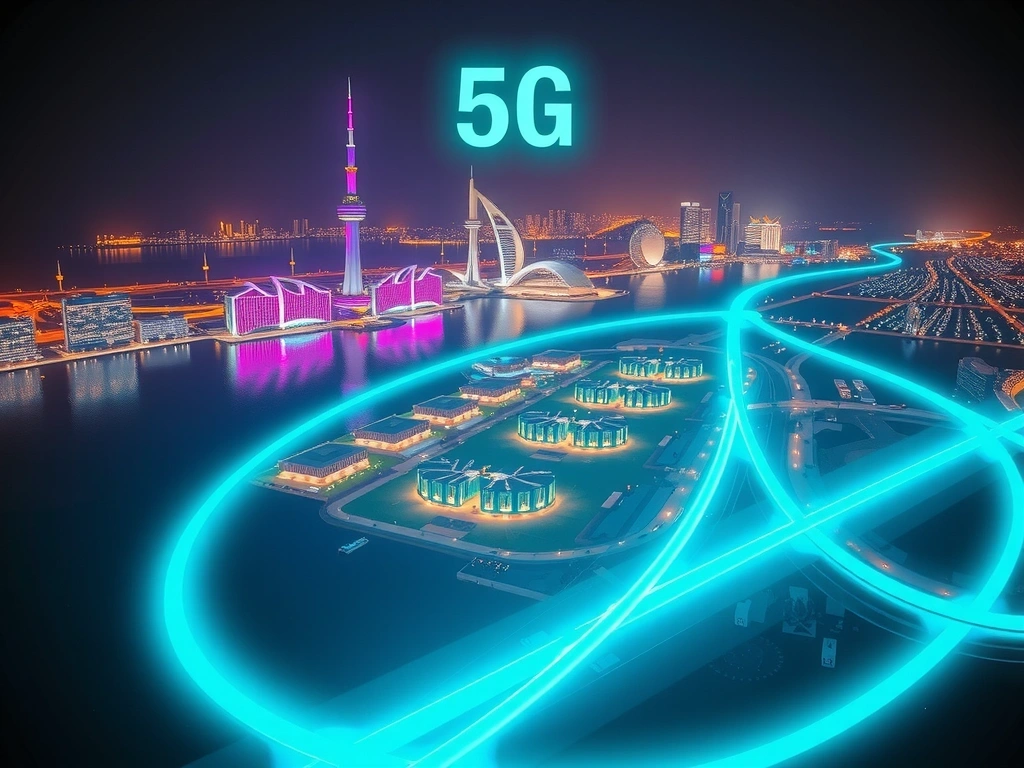
n78 3.5GHz: Wide-area urban coverage in Lusail Marina.

n258 mmWave: Micro-cell integration for West Bay high-rises.
NETWORK PULSE MATRIX
Network Slicing
Virtualized partitions that allow mission-critical services—like Hamad Port automation—to run on a dedicated bandwidth slice, isolated from consumer traffic surges.
Status: Active Slicing deployedBeamforming
Rather than broadcasting signal everywhere, our 64T64R antennas focus energy beams directly at connected devices along the Doha Expressway, reducing interference and wasted energy.
Precision: <1m AccuracyMEC Integration
Multi-access Edge Computing moves processing clusters to the edge of the Doha metro grid, slashing standard ping times for autonomous vehicle coordination in Education City.
Efficiency: 40% Latency DropFailure Modes & Constraints
The Glass Barrier Mistake
Assuming 5G penetrates LEED-certified glass. Low-E coatings in Doha’s skylines act as Faraday cages for high-band signals. Fix: Interior micro-cell relays are required for signal continuity.
Thermal Hardware Overload
Outdoor mmWave units can throttle during July/August peak heat if not actively cooled via liquid-recirculating enclosures. Insight: We utilize climate-shielded housing for all outdoor Doha expressway nodes.
Device Frequency Mismatch
Deploying a network slice for hardware that only supports Sub-6GHz. You lose the latency advantage.
SCENARIO: AUTONOMOUS LOGISTICS AT HAMAD PORT
In the industrial heart of Qatar, connectivity isn't just a utility—it's safety. At Hamad Port, a private 5G Standalone (SA) network creates a secure perimeter for autonomous container loaders.
The process follows a tight, invisible narrative:
- 01 Sensors on moving loaders trigger millisecond position updates over the high-reliability URLLC slice.
- 02 Edge computing nodes located on-site process the telemetry, making split-second avoidance decisions without routing traffic through the main Doha switch.
- 03 The result is a 99.999% uptime environment where human and robotic workflows interleave without risk of signal latency spikes.
This is the reality of 5G in Qatar—moving beyond the mobile phone and into the very gears of the nation's economy. The transition from NSA (Non-Standalone) to full SA architecture allows us to decouple from 4G cores, unlocking the true potential of massive IoT.
THE NEXUS GLOSSARY
Non-Standalone vs Standalone
NSA was the "quick start" using existing 4G cores. SA is the endgame. Without SA, network slicing is just a marketing term; with it, it's a revolutionary industrial tool.
Ultra-Reliable Low-Latency Communication
This is the "medical grade" connectivity needed for remote surgery or autonomous taxis in Msheireb. It prioritizes reliability over raw speed to ensure the connection never drops.
Vehicle-to-Everything
The protocol allowing your car to talk to traffic lights in West Bay. It’s the difference between a "smart ride" and a city-wide autonomous ecosystem.
The Invisible Spine
A 5G tower is only as fast as the fiber optic cable connecting it to the core. In Qatar, we’ve laid nearly 10,000km of high-density glass to support the wireless leap.
READY TO DEPLOY?
Whether you're developing smart-city applications in Lusail or optimizing remote operations for oil and gas infrastructure, our technical team provides the deep-dive integration expertise you need.
Implementation Constraints
Recommendations assume hardware is compliant with 3GPP Release 16 or higher. Signal estimates are based on outdoor visibility and do not account for sub-surface basement saturation. Energy efficiency targets are achieved via AI-driven sleep modes during low-traffic windows (02:00-05:00 AST).